Amsterdamse Bos renews Cherry Blossom Park
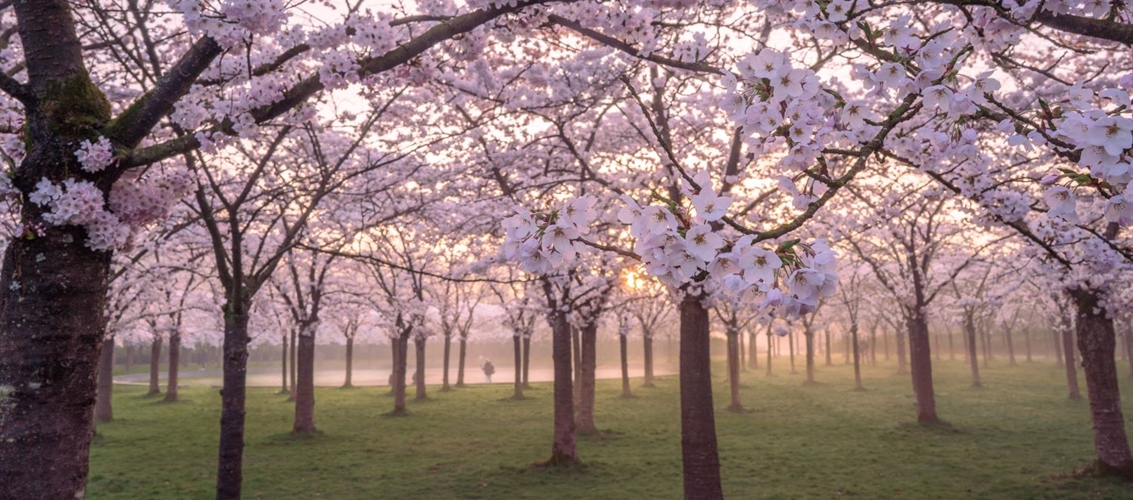
We are renewing the Cherry Blossom Park in the Amsterdam Forest. The current cherry trees are due for replacement, and we believe it is important to preserve the Cherry Blossom Park for future generations. The project involves replacing the trees, improving the soil and redesigning the layout of the Cherry Blossom Park. We expect to complete the project in the spring of 2029.
A special place
The Cherry Blossom Park, with its 400 cherry trees, is a special place in the Amsterdamse Bos. Every spring, when the cherry trees are in bloom, the Bloesempark attracts ten thousands of visitors from home and abroad. The trees in the park were donated in 2000 by the Japan Women’s Club and symbolise the bond between the Netherlands and Japan. It is a place of significance for many.
Lifespan
The cherry trees in Cherry Blossom Park are now 35 years old, as they were around 10 years old when they were planted. Under ideal conditions, these trees can live for around 40 to 50 years.
Over the past few years, we have taken various measures to extend the trees’ lifespan as much as possible, but the trees are nearing the end of their lifespan and their condition is deteriorating rapidly.
Some trees have already died and been felled in recent years; in January, we felled 12 dead cherry trees. We fell the dead trees for the safety of visitors.
Growing conditions are not ideal
The growing conditions in the Cherry Blossom Parkare not ideal for the cherry trees. One of the reasons for this is the layer of clay beneath the Cherry Blossom Park. This means that water drains poorly during wet periods and that the tree roots cannot access groundwater during dry periods. The soil contains little soil life and insufficient nutrients; in other words, the soil is compacted.
The large numbers of visitors during the blossom season cause further compaction of the soil. Another cause is the distance between the trees; to grow properly, the trees need more space.
A future full of blossoms
We believe it is important to preserve the Cherry Blossom Park and want it to remain beautiful and healthy, now and in the future. That is why we are planting new trees, improving the soil and making changes to the layout of the Bloesempark.
We have investigated whether there are any trees that we could move to the outer ring of the Cherry Blossom Park. The investigation has shown that none of the trees are suitable for transplanting.
Time of replacement
We are replacing all the trees at the same time so that we can prepare the soil throughout the Cherry Blossom Park as thoroughly as possible for the planting of the new blossom trees. We will execute these activities in 2028. This means that after the flowering period in the spring of 2028, we will remove all the trees and plant new ones in the autumn.
Those new trees will then be around 10 years old and will be planted further apart than the current trees. If all goes well, the renewed Bloesempark will bloom for the first time in the spring of 2029.
(Text continues below the photo)

Shinto ceremony
The Japan Women's Club is closely involved in the redevelopment of Cherry Blossom Park. To mark this, in the autumn of 2025, the Amsterdamse Bos, together with the Japan Women's Club and the municipality of Amstelveen, organised a joint Shinto ceremony. During this Shinto ritual, thanks were given to nature and the forces around us. Prayers were also offered for prosperity, safety and harmony for everyone involved in the project.
Protecting vulnerable trees
Both the existing trees and the new ones to be planted are particularly vulnerable due to their age. We must therefore manage visitor numbers in the Cherry Blossom Park with care. We are looking into whether there are any additional measures we can take to ensure that visits to the Cherry Blossom Park during the blossom season run as smoothly as possible.
Stay up to date
If you’d like to stay up to date with this project, please take a look at the video updates on the renovation of Bloesempark.
Frequently Asked Questions
Will we still be able to enjoy a blossoming Cherry Blossom Park in the spring in the coming years, until the trees are replaced?
Yes, we expect the trees to remain in bloom until the end of the flowering season in the spring of 2028. However, there is a chance that more trees may die off in the coming years or that fewer trees will be in bloom. The current trees will remain in place until they are replaced, after the flowering season in the spring of 2028.
Will even more trees fail to survive in the coming years?
We have carried out a thorough assessment of the condition of the trees. This has revealed that around 80% of the existing trees are in poor condition. The remaining trees are still in satisfactory condition. There are no longer any trees in good condition. We therefore expect that more trees will not survive in the coming years.
How long do the cherry trees in the Blossom Park live?
The Japanese cherry tree in the Blossom Park is Prunus x yedoensis; these trees have an average lifespan of around 40 to 50 years in optimal conditions. The current trees were planted in the year 2000. They were around 10 years old at the time, which means they are now around 35 years old.
Is the high number of visitors in recent years the cause of the poor condition of the trees?
The growing crowds that come to visit the Cherry Blossom Park are not ideal for the cherry trees. The soil in the Bloesempark is compacted. This is due to the layer of clay beneath the Bloesempark. The compaction is exacerbated by the pressure exerted by visitors on the ground around the trees. On peak days during the blossom season, this amounts to more than 20,000 visitors. Furthermore, the trees do not have sufficient space.
In 2024, the Amsterdamse Bos released worms and fungi into the Bloesempark to improve soil quality. Did that not help?
The Amsterdamse Bos has implemented various measures to extend the lifespan of the cherry blossom trees for as long as possible; one of these measures involves introducing worms and fungi. Unfortunately, none of the measures has had a sufficient impact on the trees’ lifespan to delay their replacement.
What can visitors do to keep the trees in the best possible condition until they are felled?
The Japanese cherry trees in the Blossom Park are very fragile, so their branches break easily. Please do not hang from or pull on the branches, and do not climb the trees. Please stay at least one metre away from the trunk to avoid putting extra pressure on the roots.
What happens to the wood from the felled trees in Bloesempark?
We are taking the felled trees from Bloesempark to the Amsterdam City Council’s timber yard in the Amsterdamse Bos. We are considering creating a unique memento of Bloesempark. Do you have any good ideas? If so, please send an email to deboswinkel@amsterdamsebos.nl.
The Japan Women’s Club (JWC) donated the current trees in the year 2000. Is the JWC involved in the redevelopment of the Bloesempark?
Yes, the JWC was consulted and provided advice during the planning process. Among other things, it contributed ideas regarding the tree species and the spacing between the trees.
Are the new trees of the same species as the existing ones?
For the most part, we are replanting the same species of tree, namely the Prunus x yedoensis standard tree. In addition, we are also planting multi-stemmed varieties of Prunus yedoensis and Bride, to add more variety to the landscape. All the flowering trees bloom at the same time, so the effect will be the same as with the current trees.
How big are the new trees when they are planted?
The new trees are grown at a nursery. By the time they are planted in Cherry Blossom Park, they will be around 10 years old. They will then have a trunk circumference of approximately 25 to 31 centimetres and a trunk diameter of 8 to 10 centimetres. They are therefore considerably smaller than the existing trees.
Why are all the trees being replaced at once? Can’t it be done in stages?
We are trying to create the best possible conditions for the trees so that they live as long as possible. It is preferable to replace all the trees in one go. This allows us to prepare the soil throughout the Bloesempark as effectively as possible for the planting of the new blossom trees. This is not possible if each tree is replaced individually. It also ensures that all the trees get the same start. This creates a uniform appearance for the renewed Cherry Blossom Park.
The layout of Bloesempark is being updated. What will change?
The new design for Cherry Blossom Park is still under development. The new design focuses on the ‘Blossom experience’. We are retaining the circular layout, we will make use of the inner ring, which is currently empty, and we are adding extra paths for visitors to walk along. The trees will be spaced further apart, giving them more room to grow both above and below ground.
The soil in Bloesempark is being improved. What does that mean?
In healthy soil, soil organisms ensure that the soil remains loose, aerated and rich in nutrients and oxygen for the trees. Examples of soil organisms include worms, fungi and bacteria. The soil in the Bloesempark has become compacted because the clay soil retains a lot of water. This prevents oxygen from reaching the soil and means there is little soil life present. As part of the renovation of the Bloesempark, we are loosening the soil, adding sand and installing extra drainage. This will ensure that water can drain away properly and the roots can grow well.
Will visitors be able to enjoy the Blossom Park in the same way in future?
The Cherry Blossom Park is of great cultural value and a major attraction in the Amsterdamse Bos. We believe it is important that the Cherry Blossom Park is and remains accessible to everyone. Unfortunately, the large number of visitors has had a negative impact on the soil and, consequently, on the trees. We are therefore considering measures we can take to reduce the pressure on the soil. This could, for example, mean that visitors are not allowed to get as close to the trees.
Are there any trees that are still in good enough condition to be transplanted to another location?
We have investigated whether any trees that are still in good enough condition to be transplanted to another location. Unfortunately, the conclusion is that the cherry trees are not suitable for transplanting. The chances of the trees surviving in a different location are too slim. This is because the trees’ roots lie close to the surface and they do not have enough fine roots.
Header door Dirk Drost